
When this dental practice first reached out to me, they were invisible on Google. Completely invisible. Not on page 2 — on page 5, buried so deep that their ideal patients were booking with competitors down the street who offered a similar standard of care.
Three months later, they were ranking on page 1 for their most valuable keywords, generating 15 new patient inquiries per month from organic search alone without spending a dollar on ads.
This is the breakdown of exactly what I did, why I did it, and what any dental practice can take away from this real dental SEO case study.
The Starting Point — What Was Wrong
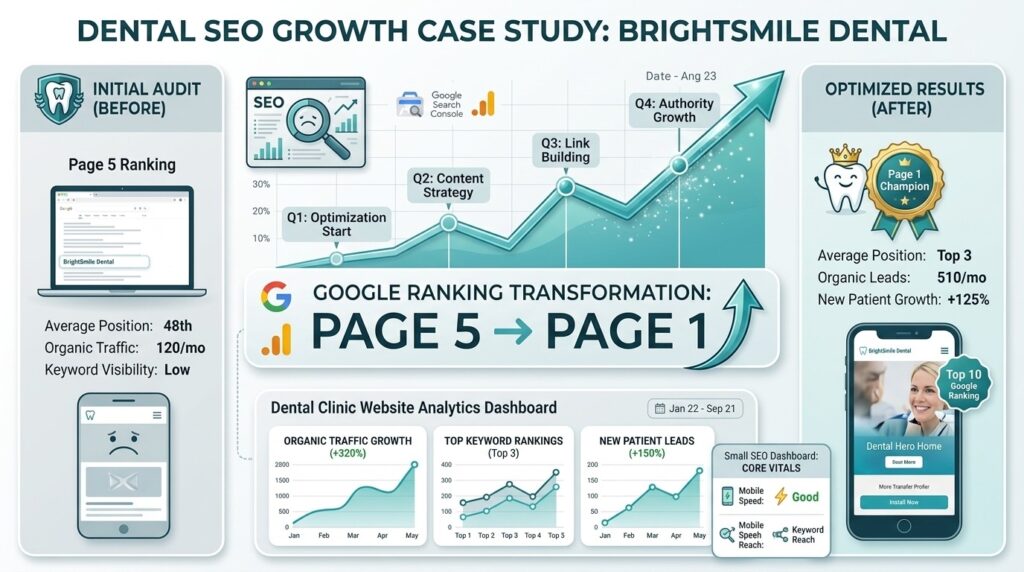
The first step was a full SEO audit. What I found was, unfortunately, extremely common for dental practices that haven’t invested in SEO:
• No meta descriptions on any page, Google was auto-generating them, and they were pulling irrelevant footer text
• Broken heading tag hierarchy: multiple competing H1s, no H2 structure, information buried in walls of unformatted text
• Zero blog content. The practice had been in business for 8 years and had never published a single educational article
• Thin service pages — each treatment had roughly 80–100 words of generic copy. No specifics, no FAQs, no local context
• Google Business Profile untouched — wrong secondary categories, no Q&A, no photos beyond the exterior, no posts in over a year
When I see a profile like this, I’m not discouraged — I’m excited. It means there’s a lot of ground to gain quickly, because the baseline is so low that even foundational fixes produce significant movement.
The 90-Day Strategy I Used
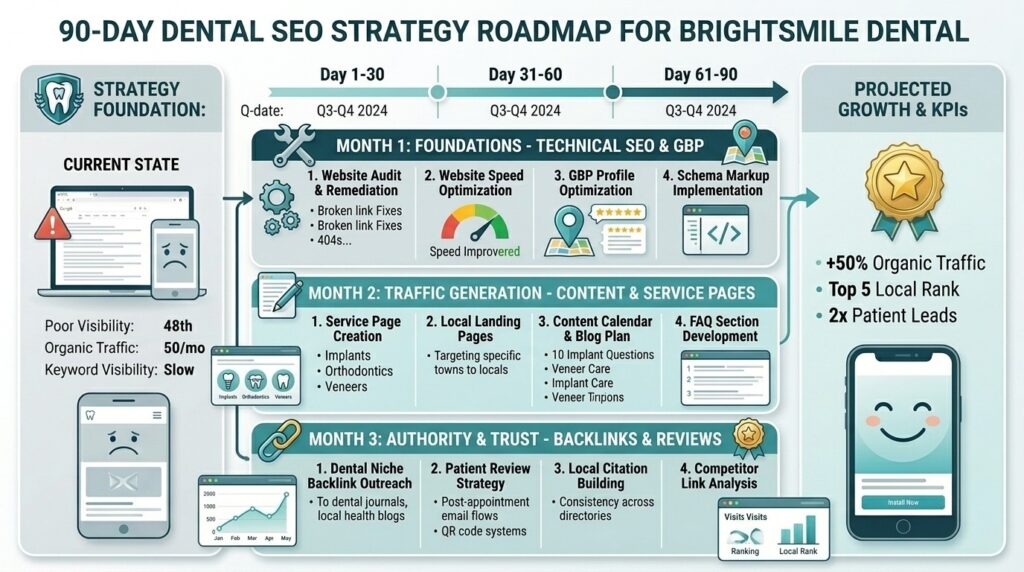
Month 1 — Technical Audit + On-Page Fixes + GBP Overhaul
We started with the foundation. I fixed every technical issue first: repaired the heading hierarchy across all pages, wrote proper meta titles and descriptions for each page with the primary keyword placed naturally, compressed all images for faster load times, and submitted a clean sitemap to Google Search Console.
Simultaneously, I completely overhauled the Google Business Profile. Updated categories, wrote keyword-informed service descriptions, seeded the Q&A section with 10 high-intent questions and detailed answers, uploaded a full batch of team, interior, and treatment area photos, and set up a weekly posting schedule.
By the end of month 1, Google Search Console was already showing increased impressions — the site was being crawled more frequently and indexed properly for the first time.
Month 2 — Treatment Page Rewrites + Blog Content Launch
Month 2 was about content. I rewrote every service page from scratch — dental implants, teeth whitening, Invisalign, emergency dentistry, and routine cleanings. Each page went from 80 words of filler to 600–800 words of structured, patient-focused content with proper H2/H3 organization, embedded FAQs, and clear calls to action.
We also launched the practice blog with four articles: a local ‘dentist near [city]’ guide, an FAQ post on dental implant costs, a comparison piece on Invisalign vs braces, and an educational post on what to do in a dental emergency. Each post was optimised for dental SEO, with proper schema, internal links to service pages, and external links to authoritative sources. You can see the broader approach I use in my post on Dental SEO in 2026: What’s Actually Working for US Practices.
Month 3 — Internal Linking + Local Backlinks + Review Strategy
With a body of content now live, month 3 was about authority. I built out a full internal linking structure — every service page linking to related blog content, every blog post linking back to the most relevant service pages. This tells Google which pages are most important and helps users navigate the site naturally.
On the backlink side, I secured listings on three local business directories, got the practice featured in a local health resource guide, and reached out to a nearby fitness studio for a cross-promotional link. None of these were high-domain-authority links — but they were local, relevant, and real.
The review strategy was simple but effective: a QR code in the reception area linking directly to the Google review form, with a follow-up text message sent 48 hours after appointments. In 30 days, they went from 12 Google reviews to 29 — a jump that directly impacted their local pack positioning.
The Results (With Numbers)
All metrics below are from Google Search Console and the practice management system, anonymised but accurate:
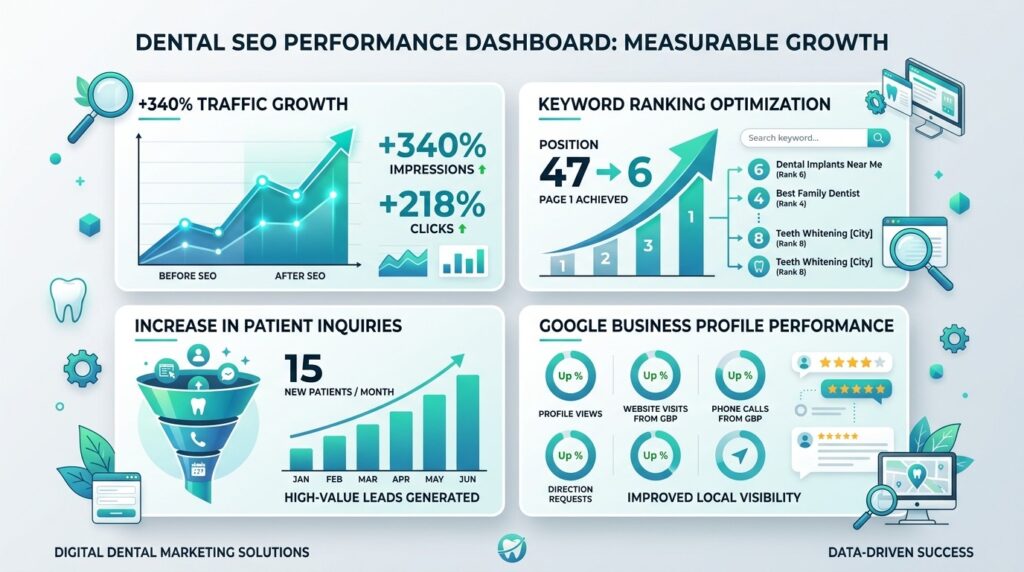
• Organic impressions: up 340% from month 1 to month 3
• Organic clicks: up 218%
• Primary keyword ‘dentist [city]’: moved from position 47 to position 6
• ‘Dental implants [city]’: moved from unranked to position 9
• Google Business Profile: phone call clicks up 85% month-on-month by day 90
• New patient inquiries from organic search: 2/month at start → 15/month by end of month 3
These are not unusual results when the starting baseline is low and the strategy is executed consistently. The compounding nature of SEO means results that looked small in week 4 became significant by week 12.
What This Practice Did Differently Than Most
I’ve worked with dental practices where results took twice as long because the implementation stalled — the dentist was too busy, the front desk didn’t have capacity, or decisions sat in someone’s inbox for weeks.
This practice was different in three specific ways:
• They moved fast — feedback on content drafts came back within 24 hours, not two weeks
• They invested in copy — they didn’t try to cut corners with AI-generated filler. Real content, written with their clinical voice and patient experience in mind
• They trusted the process — they didn’t panic when rankings dipped slightly in week 3 (normal, during a reindex), and they didn’t redirect our focus every time they heard about a new tactic
SEO is a partnership. The strategy matters — but so does the client on the other side of it.
Key Takeaways for Any Dental Practice
• Fix the technical foundation first; you cannot outrank with content if your site has structural problems
• Your GBP is not a set-and-forget; treat it like a social profile that needs regular attention
• Content volume and quality: four well-written posts beat 40 thin ones every time
• Reviews are a local ranking signal; build a repeatable, low-effort system to collect them
• Give SEO 90 days minimum before judging results—meaningful change takes indexing cycles, not days
Ready for your own page 1 story? DM me AUDIT, and let’s start with a free look at where you stand.
Learn more at nidaakbar.com — or reach out directly to get started.