
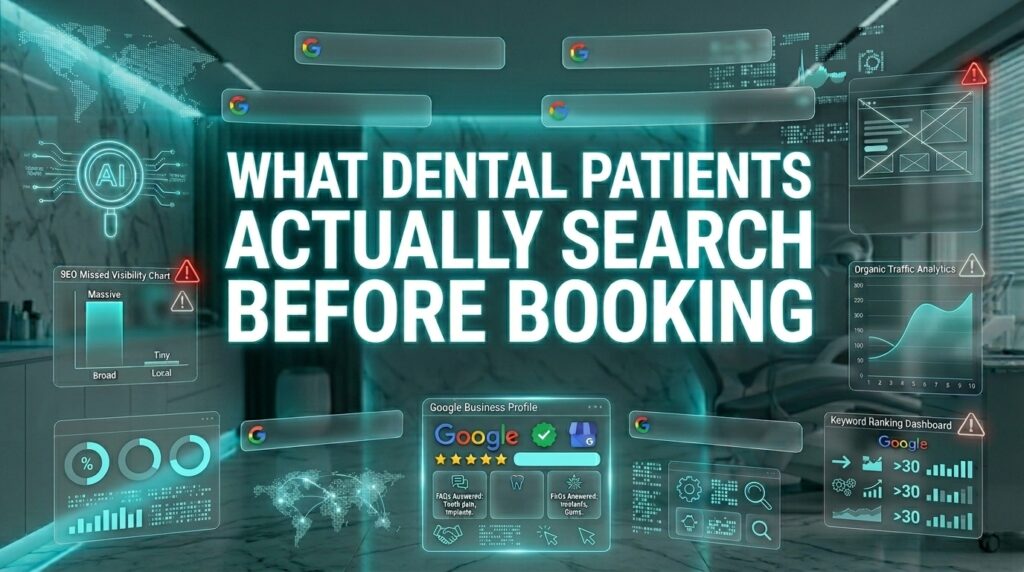
I’ve done keyword research for dozens of dental practices across Pakistan, the US, and the UK. And every single time, the same pattern shows up.
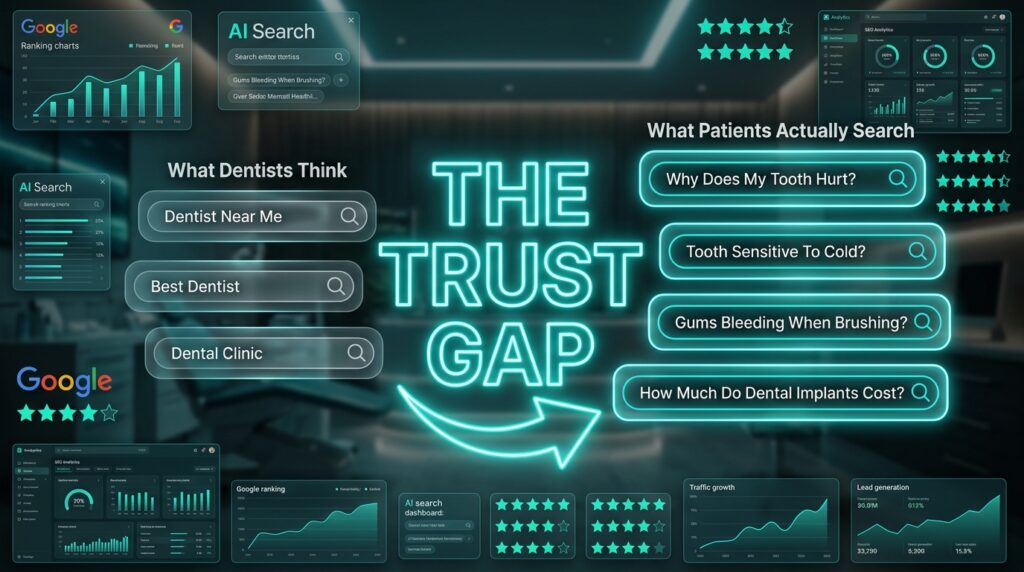
The dentist thinks patients are searching for “dentist near me.”
The patients are actually searching, “Why does my tooth hurt only when I chew something cold?”
That gap—between what dentists assume and what patients actually type—is costing practices real bookings every single month. Let me show you exactly what’s happening and how to fix it. That gap—between what dentists assume and what patients actually type—is costing practices real bookings every single month.
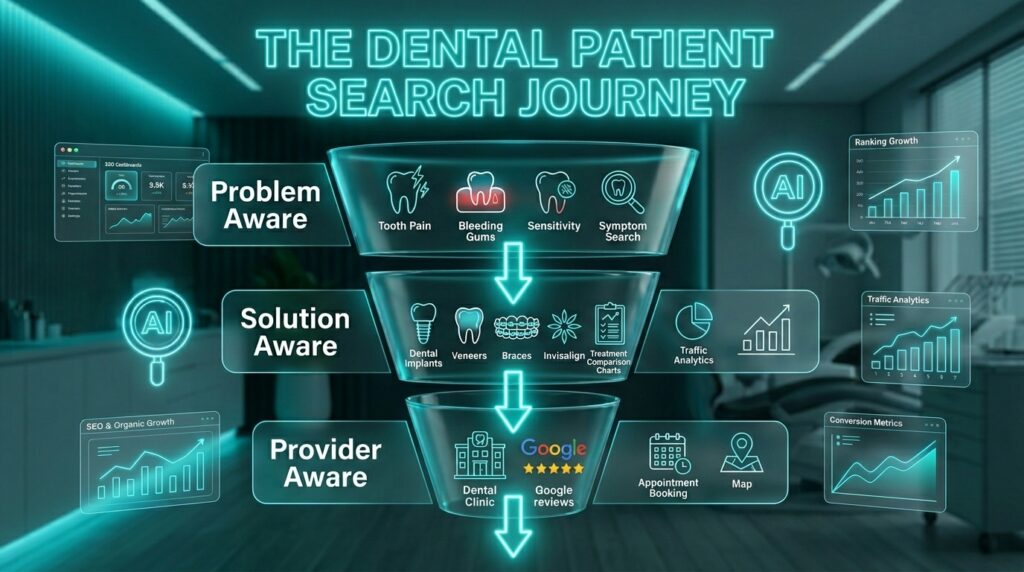
The 3 Stages of a Dental Patient’s Search Journey
Before a patient ever calls your clinic, they go through a predictable journey online. Understanding this journey is the foundation of any smart dental website content strategy.
Stage 1—Problem Aware (“Why does my tooth hurt when I bite down?”)
This is where the journey starts. The patient has pain, sensitivity, bleeding gums, or a weird bump — and they have no idea what it means. They’re not thinking about dentists yet. They’re Googling their symptom.
Real searches at this stage look like:
1. “Why does my tooth hurt when I bite down?”
2. “Is a black spot on a tooth a cavity?”
3. “Gums bleeding every time I brush.”
4. “Tooth sensitive to cold but no pain.”
Search volume on these terms? Massive. Intent to book? Still low — but this is where trust begins. If your website shows up with a helpful answer here, you become the expert in their mind before they even know they need an appointment.
Stage 2—Solution Aware (“dental implants vs bridge cost”)
Now the patient knows they have a problem, and they’re researching options. This is where comparison searches, cost questions, and treatment curiosity live.
Real searches at this stage:
1. “Dental implants vs. bridge: which is better?”
2. “How much do veneers cost in [city]?”
3. “Does insurance cover teeth whitening?”
4. “How long does Invisalign take?”
This stage has high commercial intent. Someone searching “dental implant cost” is not casually browsing—they are actively considering spending money. If your website doesn’t have a page that answers this question clearly, your competitor’s does.
Stage 3—Provider Aware (“best dentist near me for implants”)
This is the stage almost every dental website is optimized for. The patient has decided they need treatment, and they’re now looking for a specific provider.
Searches here:
1. “best dentist near me”
2. “Dental clinic open Saturday [city]”
3. “dentist accepting new patients near me”
4. “top-rated implant dentist [city]”
Your Google Business Profile, homepage, and reviews dominate here. This is important—but it’s only one piece of the puzzle.
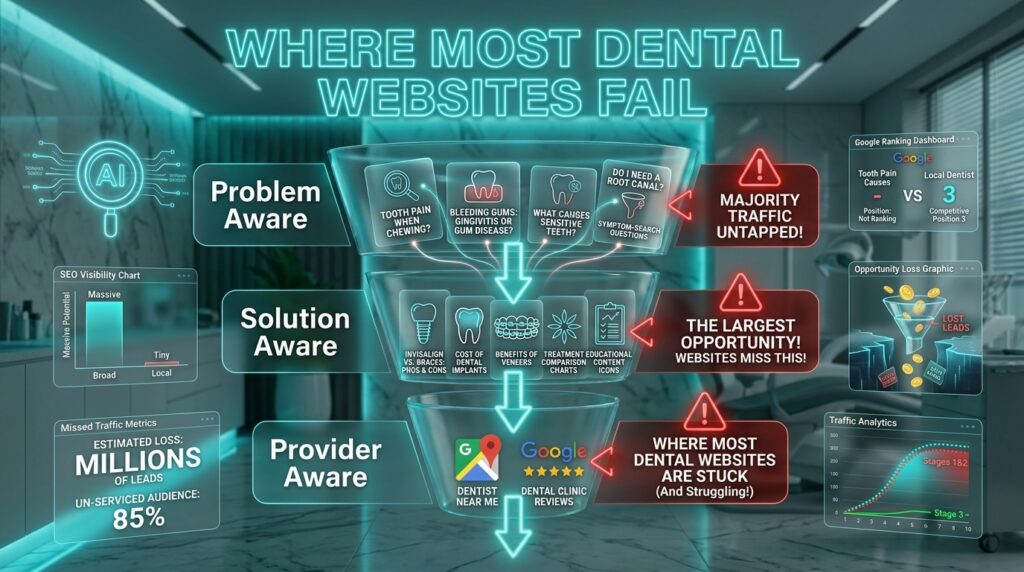
Here’s the problem: most dental websites live exclusively at Stage 3, while 80% of their potential patients are still at Stage 1 and Stage 2.
The Top 15 Questions Dental Patients Google (With Search Volume)
These are real queries patients type before they ever think about booking. The numbers below are approximate monthly global search volumes.
| Search Query | Est. Monthly Volume |
|---|---|
| why does my tooth hurt | 90,000+ |
| how much do dental implants cost | 60,000+ |
| is root canal painful | 40,000+ |
| dental implants vs dentures | 30,000+ |
| how long do veneers last | 22,000+ |
| does insurance cover dental implants | 18,000+ |
| tooth sensitive to cold | 15,000+ |
| how much do braces cost for adults | 14,000+ |
| black spot on tooth | 12,000+ |
| gums bleeding when brushing | 11,000+ |
| how long does Invisalign take | 10,000+ |
| can you fix a cracked tooth | 9,000+ |
| dental implants vs. bridges | 8,000+ |
| how to stop toothache at night | 7,500+ |
| what happens if you don’t treat a cavity | 6,000+ |
Notice something? Not a single one of these is “dentist near me.” These are the questions patients ask before they get to that stage. And the practices that answer these questions — with real, helpful content — show up first in both Google results and AI-generated answers (like ChatGPT, Gemini, and Perplexity).
Why Most Dental Websites Fail at Stages 1 and 2
Here is the truth: most dental websites are basically digital business cards. They have a homepage, an “About” page, a services list, and a contact form. That’s it.
That kind of website can only win at Stage 3—where the patient is already ready to book.
But here’s what that means in practice: you are invisible to the majority of patients who are still figuring out if they even need a dentist. You’re showing up at the finish line while your competitors are walking alongside patients from the very beginning of their journey.
There’s also an LLM dimension now. When patients ask ChatGPT or Google’s AI overview, “Is my tooth pain serious?”—the AI pulls answers from websites that actually cover these topics in depth. If your website has no educational content, you don’t exist in that answer. And AI-generated answers are becoming the first stop for health questions, not just search results.
The fix isn’t complicated. It just requires intention.
How to Build Content That Catches Patients at Every Stage
Here’s the simple framework I use for dental clients:
For Stage 1—Blog posts that answer symptom questions. Write posts like “Why Does My Tooth Hurt When I Bite Down? 5 Possible Causes.” Go deep, write like a human, and answer the question fully. These posts build trust, attract organic traffic, and get picked up by AI search tools. This is also what makes your website show up in LLM queries.
For Stage 2—Dedicated treatment pages with real information. Every service page should answer: What is this? Who needs it? What does it cost (even a range)? How long does it take? Does insurance cover it? What are the alternatives? Most dental service pages are one paragraph. Make yours five paragraphs that actually answer questions.
For Stage 3—Google Business Profile and homepage. Keep your GBP fully updated (photos, services, hours, FAQs). Your homepage should make it immediately clear who you serve, where you are, and what makes you different. Reviews belong here too.
Conclusion
Dental patients don’t wake up and search “dentist near me.” They wake up with a toothache, a question, or a fear, and they Google that first.
If your website only shows up at the moment they’re ready to book, you’ve already lost the trust-building phase. And in 2026, trust is built in search results and AI answers — long before anyone picks up the phone.
The practices winning online right now aren’t necessarily the best clinics, either. They’re the ones whose websites actually answer questions at every stage of the patient journey. Start with one blog post this month. Target one symptom question your patients ask most often. Write it like a real person explaining something to a worried friend. That’s it. That’s the strategy.